Running in Paris in Winter: Where to Run When Night Falls at 5 p.m.
From 25 October, Paris runs in the dark after work, parks close with the sun, the low quays flood and half the fountains go dry. What changes, and how to build a winter route.
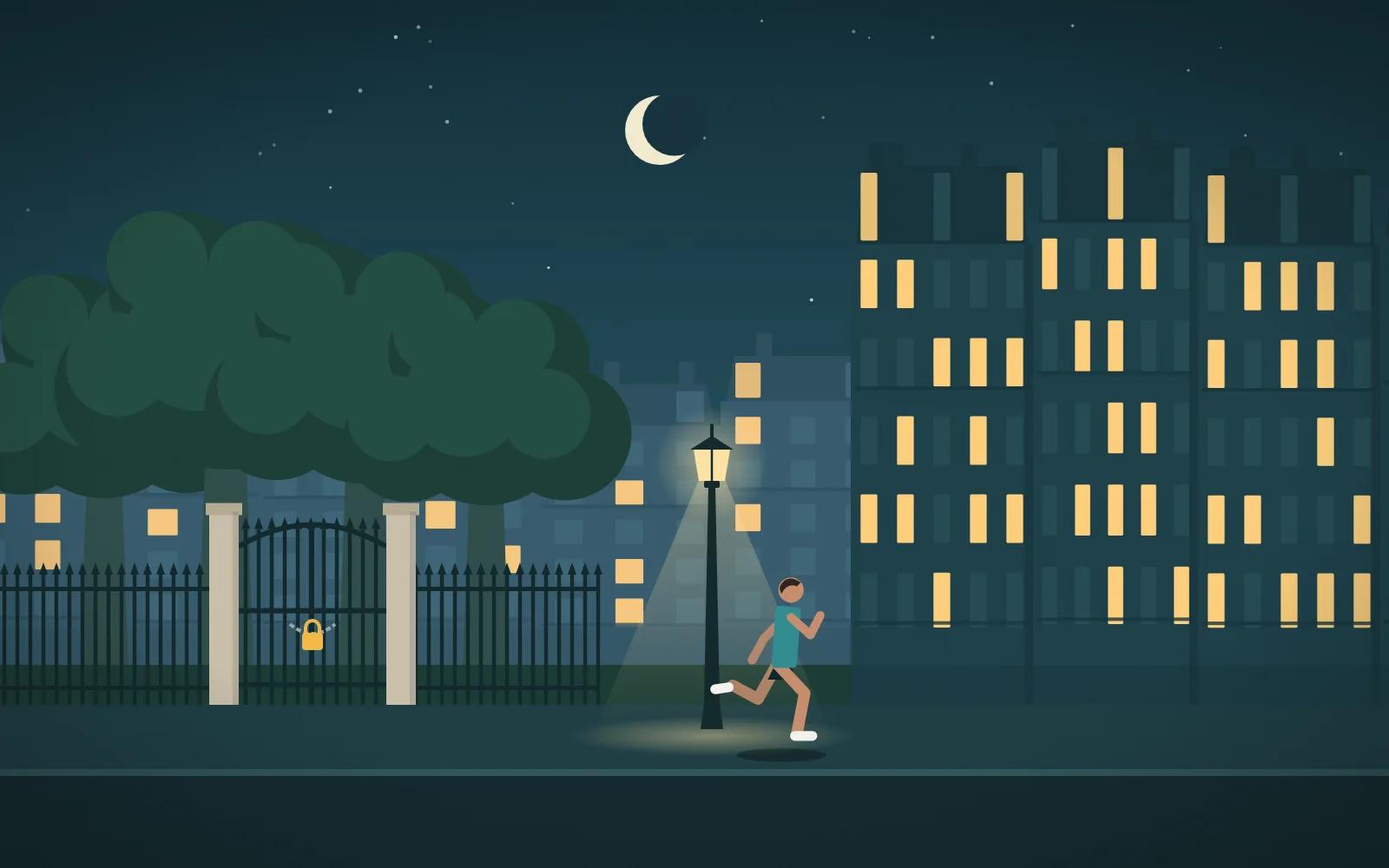
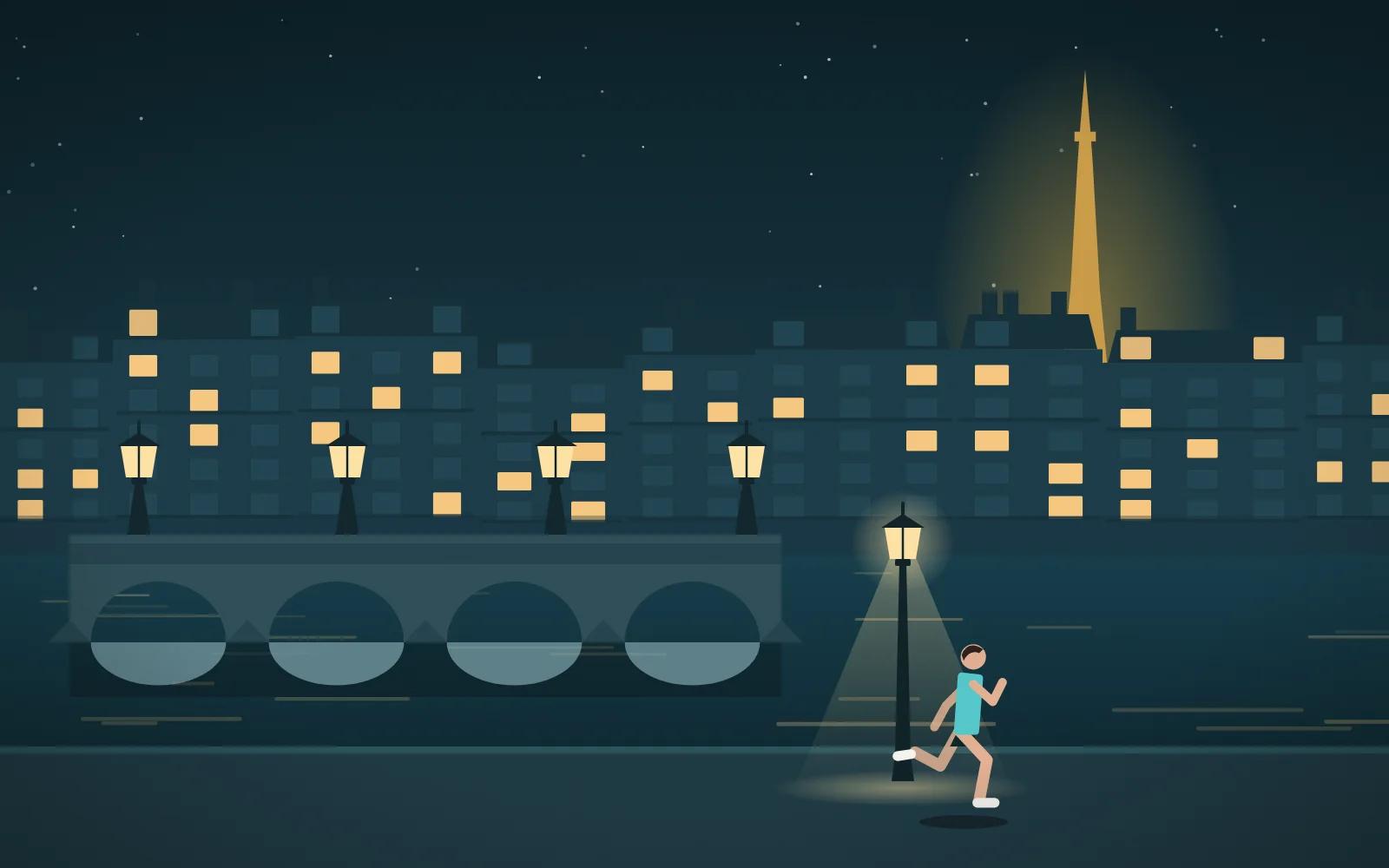
Running in Paris in winter is a question of hours before it is a question of cold. Cold is solved with one more layer. Night falling before the working day ends, park gates closing and quays disappearing under the flood are not. On Sunday 25 October the clocks go back an hour, and that evening the sun sets in Paris at around 5:40 p.m. By early December it sets before 5. For anyone who runs after work, the season that starts now is run in the dark, and it lasts until February.
This guide is not about motivation. It sets out what concretely changes in Paris between late October and March, and how to build a route that allows for it.
What changes on 25 October
The clocks change during the night of Saturday 24 to Sunday 25 October 2026: at 3 a.m. it becomes 2 a.m. It is the earliest possible date, since the European rule places it on the last Sunday of October.
The effect on running is immediate. The day before, it stays light in Paris until about 6:45 p.m.; the day after, until about 5:40. Then the days keep shortening: sunset is around 5:10 by mid-November, and around 4:55 through most of December. In the morning it works the other way: the clock change gives back some light for a few weeks, before sunrise slips past 8:30 around Christmas.
Two consequences. In the evening, almost the whole season is run at night, with what that demands: lit streets, wide pavements, few crossings. We covered all of it in our guide to night running in Paris. And in the morning, early runners keep a window of daylight before work until mid-November, which then closes.
Parks close with the sun
This is the change people forget most. City of Paris gardens do not keep fixed hours: according to the City, closing time changes six times a year to follow the average time of sunset, and in midwinter some close as early as 5 p.m. A route that crossed a park in September can run into a locked gate in November, at the same time of day.
Three practical rules:
- Hours are posted at every entrance, and that is the only source that holds for a given garden. The parks regulation also states that a garden stays accessible until its first gate closes: once one gate shuts, the others follow, and leaving by the far side is no longer guaranteed.
- Some large parks open early all year. Montsouris, Monceau and the Buttes-Chaumont open at 7 a.m., summer and winter. For running in a park during the dark season, the morning is the window.
- Close to a quarter of Paris green spaces are open 24 hours a day, according to the City. By definition these are not the enclosed parks: they are open promenades and squares without gates.
The Luxembourg and the Tuileries do not belong to the City: the first is the Senate's garden, the second is run by the Louvre. Their hours follow the season too, and are posted at the gates.
The woods: the avenues yes, the undergrowth no
The Bois de Boulogne and the Bois de Vincennes do not close: they are open spaces crossed by roads. But the City's regulation for parks and woods is explicit: access to the undergrowth is forbidden from nightfall until daybreak. On a winter evening, the forest loops you run in summer, in the Bois de Vincennes as in the Bois de Boulogne, are no longer an option. What remains are the wide avenues and the lake circuits, which are worth running by day before you try them at night.
The quays and the flood
Winter is flood season on the Seine, and the low quays are the first to close. As recently as February 2026, when the river rose, the riverside roads were closed in stages, the Rives de Seine pedestrian promenades were fenced off and the Île aux Cygnes was shut to the public.
For a runner, that means the low quays, the best route in Paris the rest of the year, can vanish from one day to the next, sometimes for a week or more. Before you set off, check the level Vigicrues forecasts for the Paris-Austerlitz station, and keep a variant along the upper quays, which are streets and stay open outside exceptional floods. The Canal Saint-Martin and the Canal de l'Ourcq are the other long car-free line in the city.
Fewer fountains
Part of the Paris fountain network is shut off during the cold months to protect the pipes from frost. Eau de Paris keeps around sixty fountains open all year, even in frost except in extreme cases, first of all for people living on the street. You sweat less in winter, but over 15 km you still drink: a fountain you found in summer is not a fountain you can count on in January. Our fountain guide covers the network; in winter, carry a small flask on long runs.
Rain, leaves and cobbles
There is nothing specific to Paris about the rain, except its surfaces. Three of them turn treacherous when wet: cobbles, the white painted stripes of pedestrian crossings, and the dead leaves piling up on tree-lined pavements in November. The sand avenues of the Champ-de-Mars and the Invalides turn heavy and slippery after rain. None of it is impossible, but it is the argument for choosing wide, even pavements over shortcuts in winter.
Building a winter route
What works in practice, when you run after work between November and February:
- Start from home rather than from a park. A loop through streets and upper quays depends on no gate.
- Look for light and width. Wide pavements and lit streets matter more at night than by day: you see the obstacles, and you are seen.
- Cut the crossings. At night, every crossing asks for more attention; a route with fewer lights is also a safer one.
- Keep the parks for the morning or the weekend, when they are open and it is light.
That is exactly the kind of loop RunninParis draws from your address: the distance you want, favouring wide pavements, trees, pedestrian streets and the quays. One honest caveat: the app does not know park opening hours yet. It shows how much of your route goes through parks; on a winter evening, that is the share to check before you leave.
Winter in Paris is not the season you run less. It is the season you run somewhere else.