Running the Petite Ceinture: What Paris's Ghost Railway Is Actually Worth
A 32.5 km abandoned railway circles Paris, and the city reopens a little more of it every year. Here is what you can genuinely run on it — and what is wishful thinking.
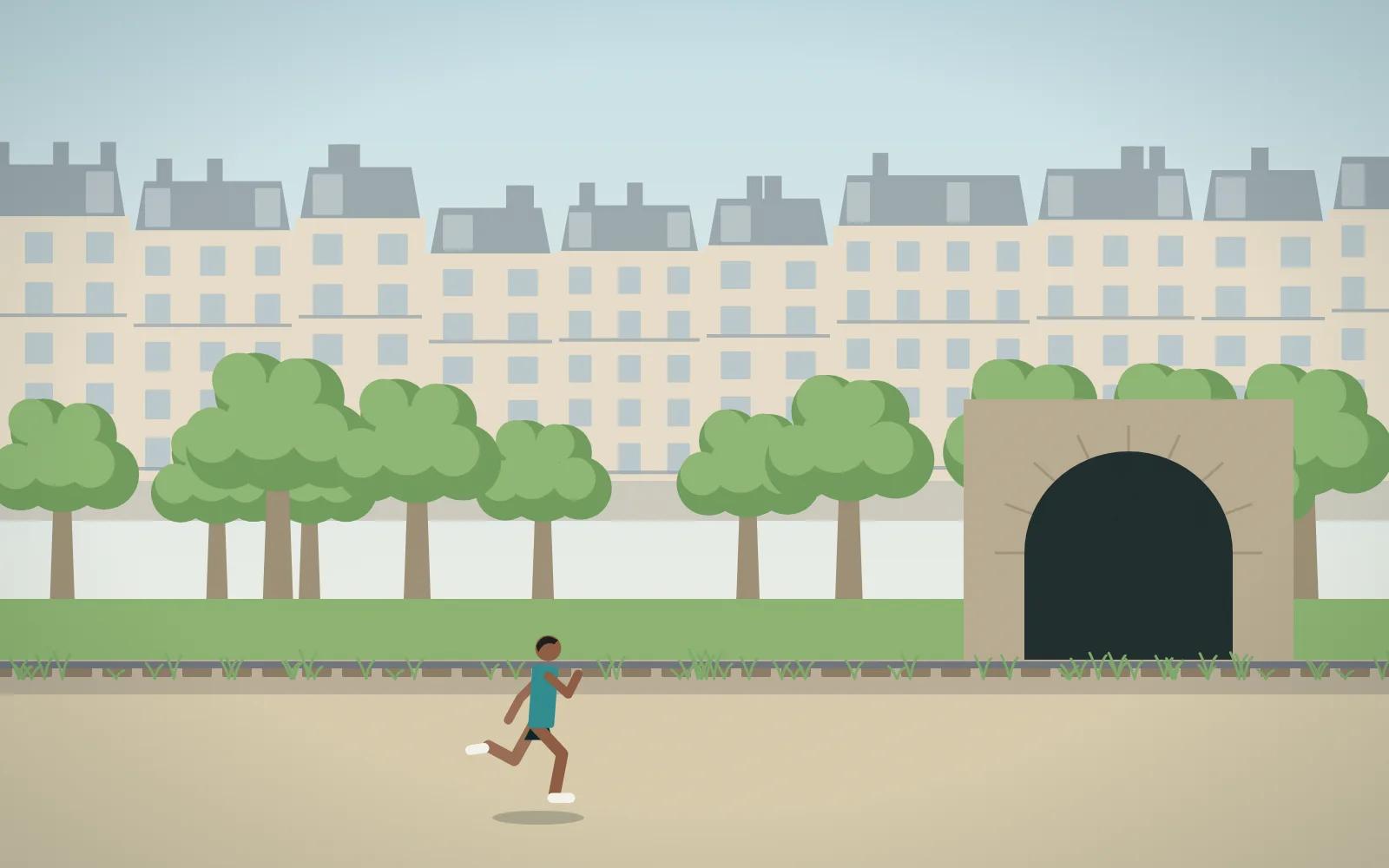
There is a railway line that goes all the way around Paris, just inside the Périphérique, and it has been mostly abandoned since passenger service ended in 1934. Thirty-two and a half kilometres of cuttings, embankments, tunnels and overgrown ballast, circling the entire city. Every runner who discovers it has the same thought within about four seconds: a car-free ring road for running. It is a wonderful idea and it is not, today, true — but the reality is more interesting than the disappointment suggests, and it is getting better every year.
What is actually open
The city has been reopening the Petite Ceinture in pieces since 2007, and there are now walkable, publicly accessible sections in the 12th, 13th, 14th, 15th, 16th, 17th, 18th, 19th and 20th arrondissements. The most useful stretch for a runner is the one in the 15th, running roughly from Balard toward the Rue Olivier de Serres — over a kilometre of continuous, flat, entirely traffic-free path in a rail cutting below street level, which is about as close to the fantasy as the network currently gets. The 16th has a green nature trail section between Porte d'Auteuil and La Muette, though this one is managed as an ecological walk and running is not really its purpose. The northeast is where the growth is: a new section opened in the 19th in April 2026 near the Rue Petit and the Avenue Jean-Jaurès, and the city has committed to opening roughly four more kilometres by the end of the year.
One clarification worth making, because it trips up almost everyone: the Coulée verte René-Dumont — the elevated planted walkway from Bastille out toward Vincennes, the one that inspired New York's High Line — is not the Petite Ceinture. It is a different disused railway, the old Vincennes line, and it is a genuinely excellent 4.5 km run in its own right. If someone tells you they run the Petite Ceinture every morning, this is usually what they mean.
How to run it without getting frustrated
The mistake is treating the Petite Ceinture as a route. It is not one, and it will not be one for many years — the open sections are separated by tunnels, private land, active freight track and long stretches that remain closed for good reasons. Sections keep the opening hours of Paris parks, which means they are shut early in the morning and after dark, exactly when many people want to run. Access is usually by a staircase or a ramp from street level, and the surfaces range from smooth stabilised path to loose ballast and gravel.
Treat it instead as texture. A section of the Petite Ceinture is a two-hundred-metre to one-kilometre gift dropped into the middle of an ordinary neighbourhood run: a stretch where the traffic disappears, the noise falls away, the temperature drops a couple of degrees in the cutting, and you are running through a corridor of buddleia and rusting rail that most Parisians have never set foot in. Strung into a longer loop through the 15th, the 14th or the 19th, it changes the character of the whole run.
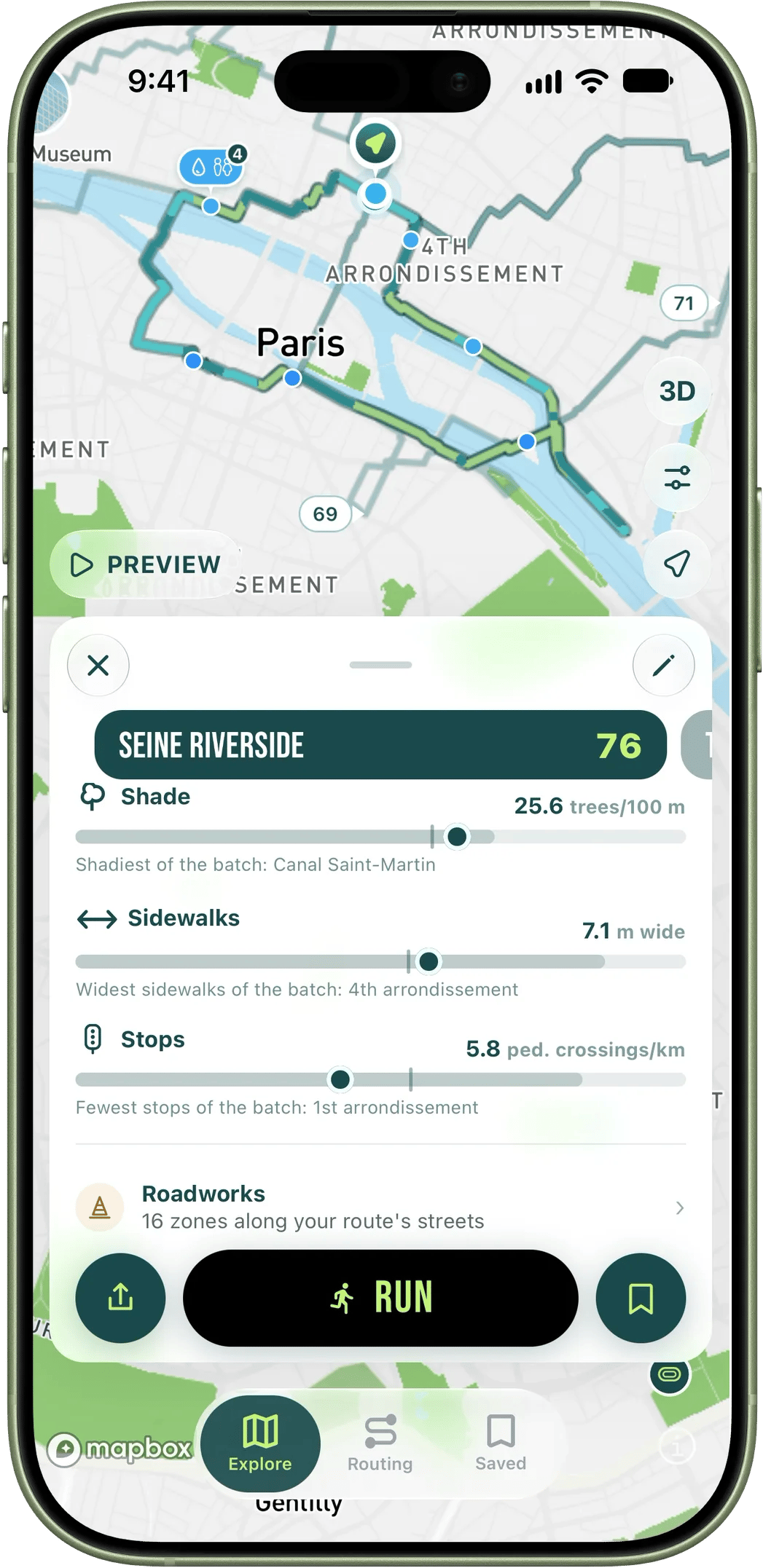
That is exactly how the scoring engine sees it too. A path with no cars, no crossings and heavy tree cover scores extremely well, so when a reopened section sits near your starting address, routes that use it tend to rise to the top of the suggestions on their own — you do not have to know it is there. Set your address and your distance, look at what the map draws, and you will find corners of Paris a block from your door that you had no idea were open.
The routes that use the Petite Ceinture, map and GPX: where to run on the Petite Ceinture.