The Long Run in Paris: How to Build 15, 20 or 25 Kilometres That Hold Together
Past fifteen kilometres, Paris stops being an easy city to run. Lights, crowds and water become the real subject. Three architectures that work, and the one thing to plan first.
A bad five-kilometre route in Paris is a mild irritation. A bad twenty-two-kilometre route is a ruined session. This is the thing that surprises people who move here and start training for a half or a marathon: the city that felt charming at 10K becomes actively hostile at 20K, because every friction compounds. Fifteen red lights across five kilometres costs you a couple of minutes and some rhythm. The same density across twenty-two kilometres costs you the entire physiological point of the session, which was to run continuously at an easy effort for two hours. Building a good long run in Paris is a genuinely different skill from building a good short one.
Three architectures that work
The first is the ribbon: string the car-free corridors end to end and run them in a line rather than a loop. The lower Seine quays connect to the Canal Saint-Martin at the Bastille, and the Saint-Martin runs into the Bassin de la Villette and out along the Canal de l'Ourcq toward Pantin. Run it out and back and you have well over twenty kilometres of almost entirely uninterrupted, flat, lit path. This is the single most reliable long-run structure in Paris and it is why so many Parisian marathon plans quietly happen along water.
The second is the wood with an approach: run the three or four kilometres from your door out to the Bois de Vincennes or the Bois de Boulogne, do your volume on packed dirt inside the forest, and run home. You get the surface benefit for the bulk of the session and the road mileage acts as warm-up and cool-down. For anyone in the 11th, 12th, 16th or 17th this is the best structure available.
The third, and the most underrated, is the clover: two or three medium loops that all pass back through your own front door. It sounds inelegant and it is tactically brilliant. You get a water and gel stop every forty minutes with no carrying, you can bail at any lap if the session is going badly, and in July and August you can stash a cold bottle on your own doorstep. Marathon runners in dense cities use this far more than they admit.
Water is the actual problem
Everything else about a Paris long run is solvable. Water is the thing that ends sessions. Paris is genuinely well equipped here — the city has well over a thousand drinking points, including around a hundred surviving Wallace fountains, the green cast-iron ones donated after the siege of 1870–71 — but they are unevenly distributed, and the ones inside parks and gardens follow the gates rather than staying open around the clock. A significant number of street fountains also run through the winter, but the seasonal ones do not, so a route that works in August can be dry in January.
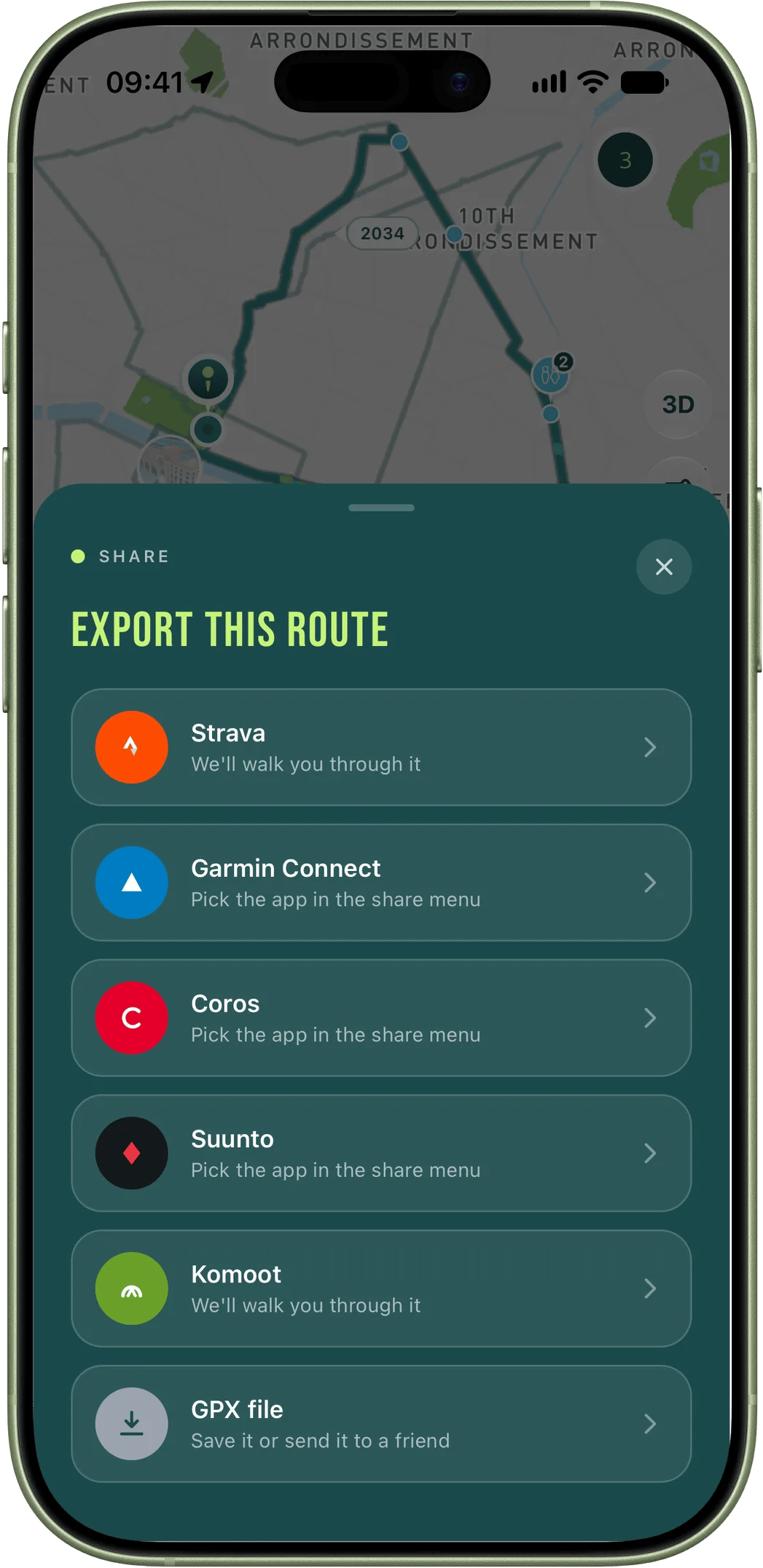
This is precisely what the app was built to solve, and it is not a marketing line: the fountain and toilet overlays come straight from the City of Paris open data portal — the fontaines-a-boire and sanisettesparis datasets — refreshed on a schedule, because a fountain that worked last season may be out of service this one. Set your start, ask for twenty or twenty-five kilometres, and you get several route options scored on green cover, sidewalk width and crossings, with the water points drawn on the map before you leave. Pick the one whose refills land where you actually want them, save it, and export the GPX to your watch. The long run is the session that rewards planning most, because it is the one where being wrong costs you two hours instead of twenty minutes.
To pick a concrete starting point: every 15 km route in Paris, with their climbing and the fountains along the way — on a long run, water is what you plan.