The Running Commute in Paris: How to Run to Work and Actually Do It
Running to work in Paris is faster than the Métro for distances under 6 km and more reliable than any bus. A practical guide to making the run commute a real part of your week.
Running to work is one of those habits that sounds like something other people do until the day you actually try it and realize it has been available to you the whole time. In Paris it is particularly accessible. The city's running infrastructure — the pedestrianized corridors, the wide boulevards, the canal and river paths — connects most major employment districts to most major residential neighbourhoods in a way a runner can exploit directly. Paris is not enormous: 10.5 kilometres from the Porte de Vincennes to the Porte d'Auteuil, 9.5 kilometres north to south. Most Parisian home-and-office pairs are within 5 kilometres of each other. That 5-kilometre run is 25 minutes, competitive with the Métro door-to-door on most cross-city routes during rush hour, and it gives you your full workout before the day starts.
The running commute is not new — you will see them every morning on the quays, the canal and the wide sidewalks of the grands boulevards. But there is a specific version people give up on, and a specific version that sticks. The difference is almost entirely logistical rather than motivational. The fitness is not the obstacle; the wet kit at the office, the shoes that smell, the bag that throws off your gait, the route that keeps you at red lights — these are the things that send people back to the Métro. This guide solves for those specifics.
Building the route
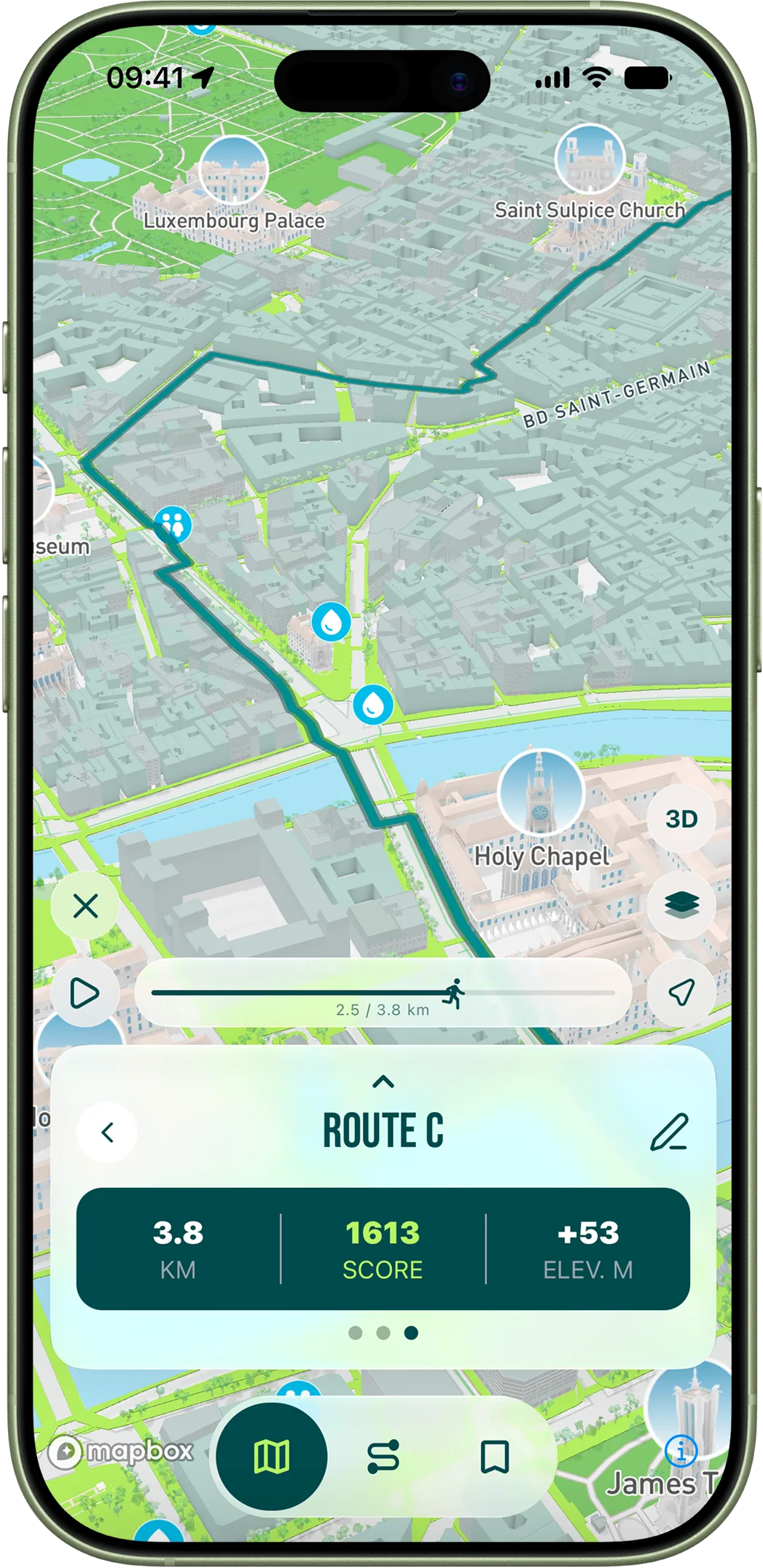
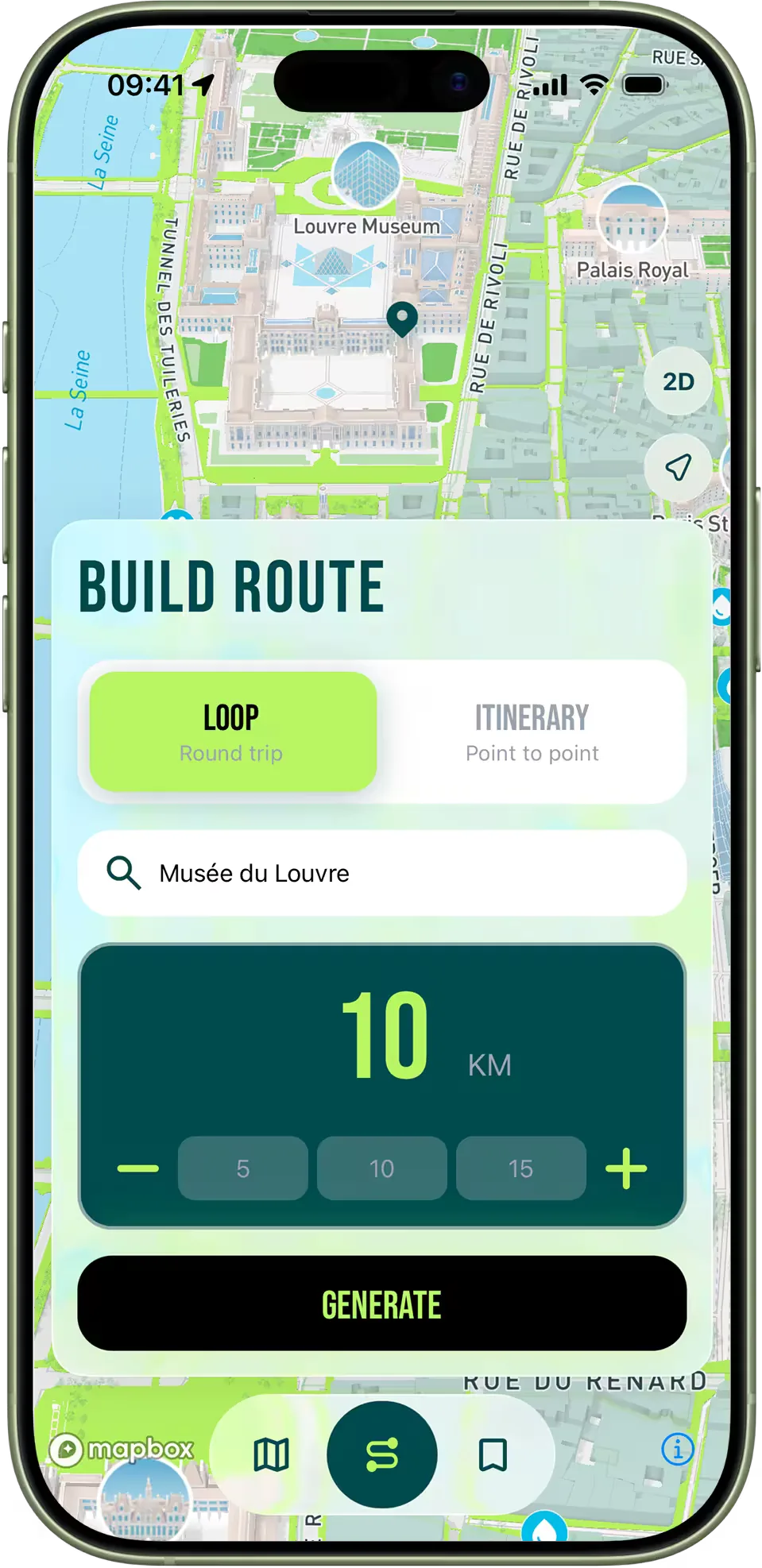
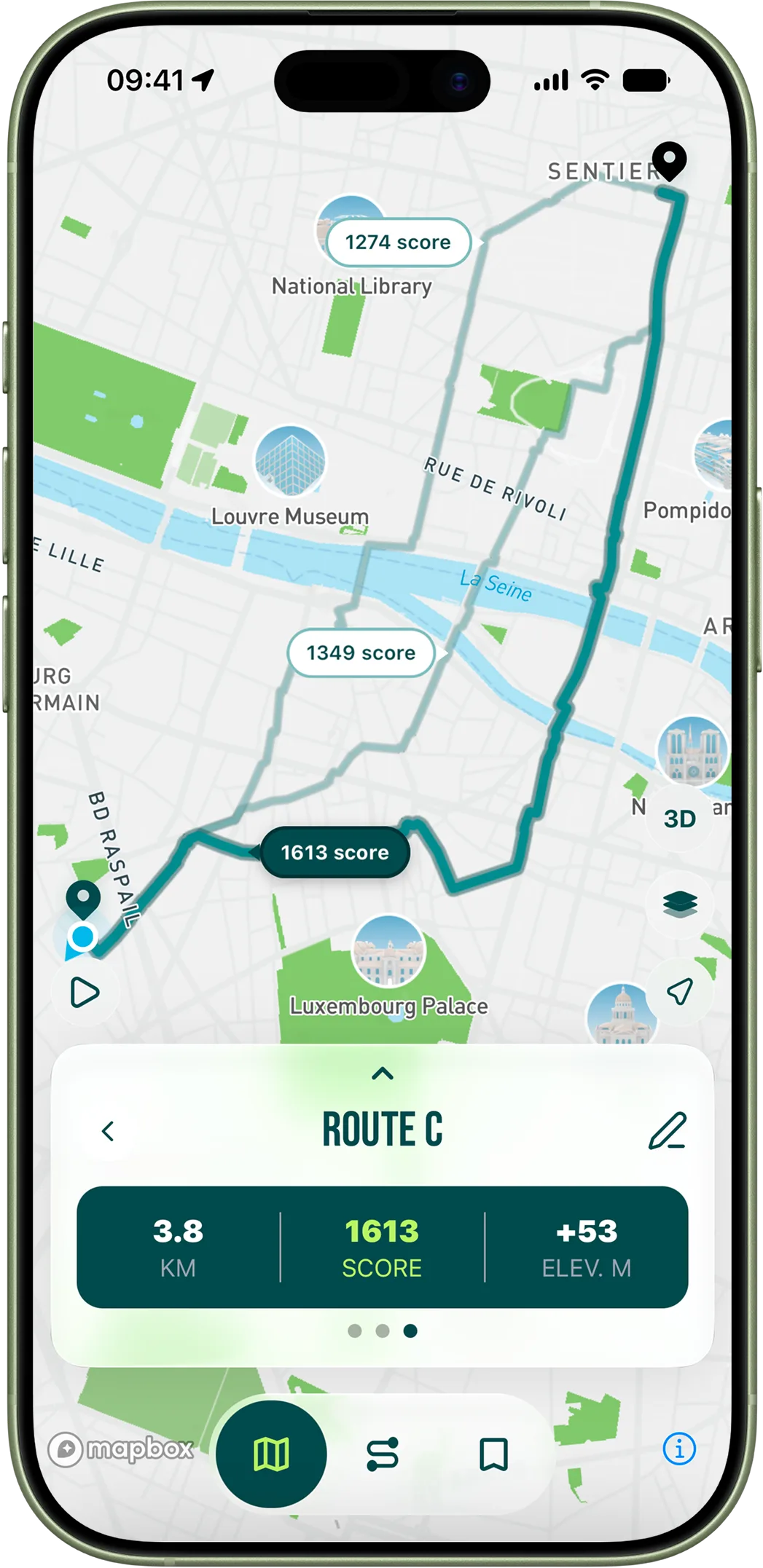
The core principle for a commute route differs from a leisure route: you need a route you can run in predictable time with predictable conditions, regardless of the day. That means: minimize traffic light exposure; maximize the use of pedestrian zones, canal towpaths and river quays; keep distance consistent; and make start and end points literal — your building's front door to your office's front door. The RunninParis itinerary mode is designed for exactly this. Enter your home address and your office address, set the distance slider to let the algorithm find a direct route, and it will generate a route that prioritizes high-scoring streets — in practice fewer lights, better surfaces, more pleasant running — between your two points. Run it once as a test, note where it deviates from what you would intuitively choose, and adjust from there.
The practical Paris commute route types depending on where you live and work: the Seine quay commute (any combination of right and left bank between the 1st and 12th), the Canal Saint-Martin commute (connecting the 10th, 11th and 19th with the 3rd, 4th and 2nd), the boulevard commute (the Haussmann grid from the 8th toward the 1st, 2nd or 9th), the Marais crossing (connecting the 11th to the 1st or 4th), and the south cross (connecting Montparnasse or the 14th to any destination north of the Seine via the Luxembourg and the rue Soufflot). Knowing which type your commute falls into tells you what to expect: the quay commute is fast, flat and beautiful; the boulevard commute is efficient but noisier; the canal commute is the best of both for anyone whose geography makes it possible.
The logistics that actually matter
Kit and shoes are the first logistical problem. Running to work means arriving with everything you need: either carry it all in a running pack, or leave it at the office in advance. The pack option works with a well-designed 5 to 10-litre running pack — enough for a change of clothes, shoes, a small towel and toiletries. It needs a sternum strap to prevent bouncing and an accessible water bottle pocket. If you commute three or four days a week, leaving a full change of clothes at the office on Monday and running with only your running kit changes the logistics dramatically. You carry almost nothing, run faster, and retrieve your office clothes from the desk drawer rather than from a sweaty backpack.
The shower question frequently stops people before they start. The honest answer: most Paris offices do not have showers. Three pragmatic solutions. First, the wet-wipe-and-change approach — a two-minute change and freshen-up in a bathroom stall is genuinely sufficient for a 5-kilometre run at moderate pace in cool weather. Second, the gym membership approach — find a gym within 200 metres of your office (there are several in every major Paris employment district) and negotiate shower access only; some gyms offer shower-only memberships at low cost. Third, the timing approach — run on days when you do not have early morning meetings; a 9:30 a.m. meeting after an 8 a.m. arrival gives you ninety minutes for a cool-down walk on the last kilometre, a change, and breakfast.
Return commutes and the split week
The running commute does not have to be symmetric. One of the most effective patterns is the asymmetric commute: you run to work on two or three mornings a week, and take the Métro back on those days. The return journey after a full workday is logistically simpler but physiologically harder — legs are tired, motivation lower. Most experienced running commuters reverse this: they run in the morning when willpower is highest and return by Métro. They use the return journey to recover, not to train. If you insist on running both ways, treat the return as a genuine easy run, not the same pace as the outbound.
The most robust running commute patterns I have observed in Paris are three-run patterns: Monday outbound, Wednesday outbound, Friday outbound. Three runs of 5 kilometres is 15 kilometres of structured movement per week added without any dedicated training time outside normal schedule. Over a year that is approximately 780 kilometres of running that would otherwise have been zero. The fitness effect is significant and requires no motivation infrastructure beyond leaving your running clothes by the door the night before. The app saves the commute route in your library under one tap. The morning version of you just has to follow the saved trace. Start next week. The Métro will feel very slow by comparison.